
_.png)
Peer Review
Abstract:
Major comments:
-
Line 41: More than 95% of patients in the original apixaban group were dropped to reach the 2,533 pairs. Provide more insight on how you ensured that the matched sample was representative of the original treated population.
-
Line 42: The massive difference in the size of the cohorts may prevent any of the conclusions listed about each cohort to have any true relevance because of the removal of essentially 45,000 participants. While somewhat addressed in the conclusion, further information at minimum on what assumptions and characteristics were used to drive the propensity score matching would help to address this issue.
-
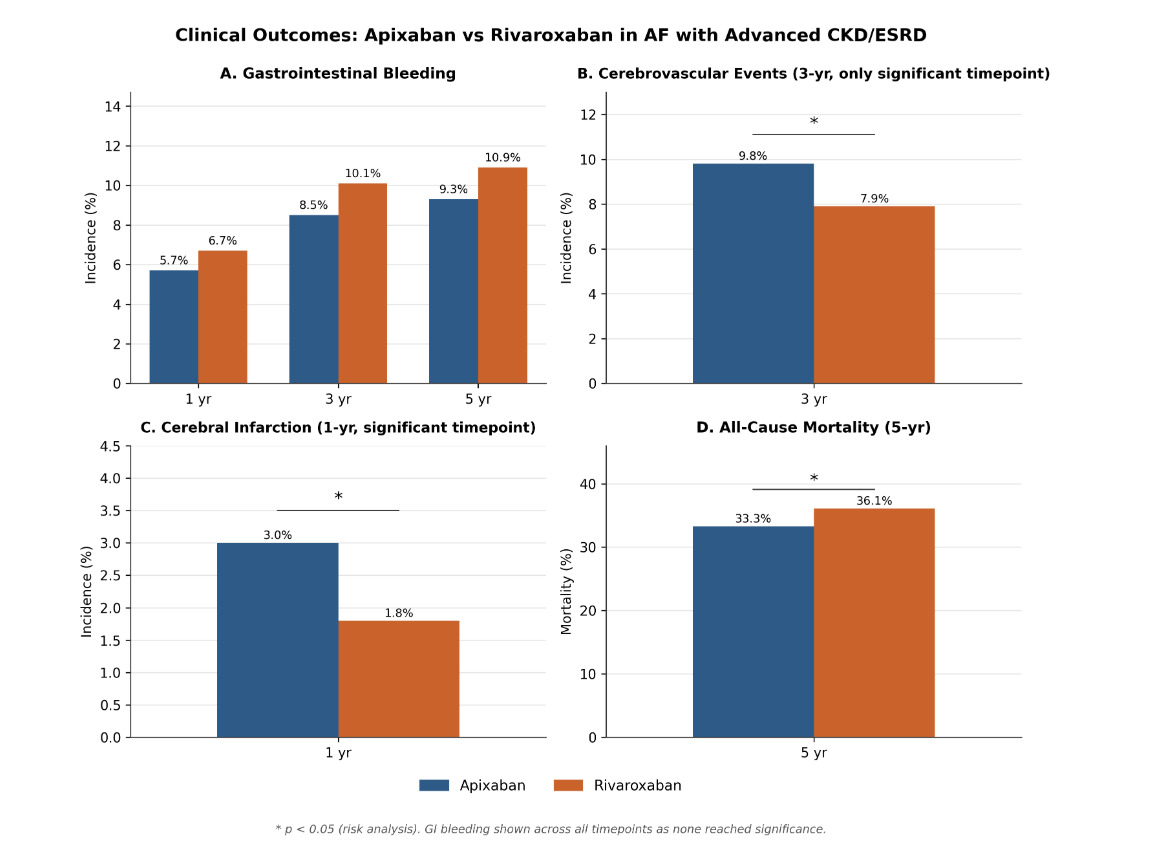
Lines 53-54: Please provide insight on why cerebrovascular events were significant at the 3-year timepoint but not at the 1- or 5-year timepoints. Please clarify whether the analysis adjusted for multiple comparisons, being sure to specify which test was performed. If not, be sure to describe your results more cautiously, noting that some findings may be due to chance rather than a true treatment difference.
-
Lines 46-47 & 56-57: In your Methods section, you describe that MI is assessed as an exploratory endpoint, but your Results section states “MI was consistently higher with apixaban across follow-up” with the same weight as your primary bleeding and stroke findings. I would recommend phrasing this more cautiously with an emphasis on its exploratory status.
-
Lines 57-58: Please explain why the 5-year mortality risk was significantly lower with apixaban but the time-to-event analysis shows no significant survival difference. Which result should be relied on? I would recommend explaining why the findings diverge. Were there any patients differentially excluded due to loss to follow-up? Assuming a Cox model was used, is the proportional hazards assumption of RR remaining constant over time violated with a shifting trend in mortality difference?
Minor comments
- Line 60: I would not use the phrase “trended towards” as this implies that conclusions can be made from this data, which is not true. Instead, I might use the wording here: “In this propensity-matched cohort, apixaban was not associated with significantly greater bleeding risk than rivaroxaban. Additionally, there may be a signal that apixaban is associated with lower gastrointestinal bleeding, which is worthy of further investigation.”
Funding
None to report
Conflict-of-interest statement
The authors have no relevant financial or nonfinancial interests to disclose.
IRB approval/exemption
Data were obtained by executing prespecified queries within TriNetX. The platform returned deidentified, aggregate data, and no directly identifiable patient information was accessed. As such, it was granted exemption by the Western Institutional Review Board, and no additional institutional review board approval or informed consent was required.
Corresponding Author
Muhammad Sajawal
Howard University Hospital
Email: Sajawalmalik.md@gmail.com
2041 Georgia Ave NW, Washington, DC 20060 202 262 4649
I allow the email to be published if needed.